
English

Author: Site Editor Publish Time: 2026-03-26 Origin: Site


In fixed orthodontic treatment, conventional metal brackets remain one of the most widely used options in daily practice.
They have a long clinical history.
The manufacturing process is mature.
They are easy to use chairside.
At the same time, they offer a strong balance of cost-effectiveness, reliability, and clinical practicality.
That is why they continue to be a standard choice for many orthodontic practices.

01 | Two Main Types of Conventional Metal Brackets
From a structural standpoint, conventional metal brackets generally fall into two categories:
→ Mesh Base Brackets
→ Monoblock Brackets
In the market, clinicians are often presented with a wide range of claims and product descriptions.
Some focus on bond strength.
Some highlight safety.
Others emphasize appearance or price.
So when choosing between these two bracket types, the real questions are:
What is the structural difference?
How does that difference affect clinical use?
Which factors matter most when making a purchasing decision?
02 | Material Is Not the Main Differentiator
In terms of material, both types are typically made from medical-grade 17-4 stainless steel.
In some Mesh Base designs, the mesh itself may use 304 stainless steel, but in practical terms, this is not usually the deciding factor for clinicians.
The real distinction is not the material itself.
It is the bracket structure and manufacturing method.

03 | The Key Difference Lies in Structure and Manufacturing
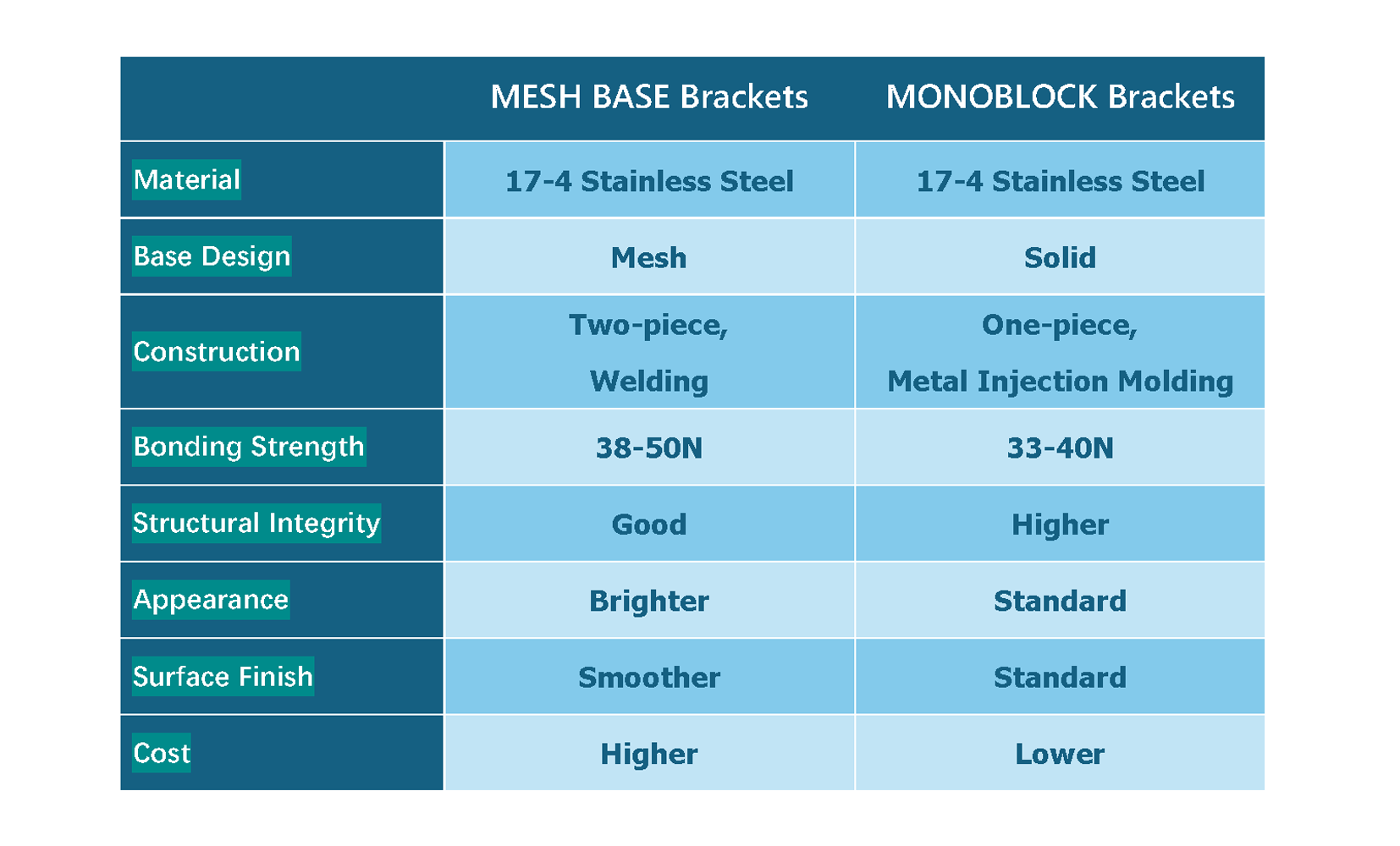
Mesh Base brackets are typically made as a two-piece construction.
The bracket body is formed first, and the base is then attached by welding.
One advantage of this design is that the base can be engineered more flexibly.
A pre-formed mesh base can generally adapt better to the tooth surface and help maximize the effective bonding area.
In clinical use, this often translates into a bracket that feels more adaptable at bonding and more efficient in everyday handling.
Monoblock brackets are produced as a one-piece structure.
The bracket body and bonding base are formed as a single unit during manufacturing, without a separate base welding step.
The main advantage of this design is greater structural integrity.
Because there is no welded joint between the bracket body and the base, the risk of separation at that interface can be reduced.
04 | Bonding Performance: Mesh Base Brackets Usually Have the Advantage
For conventional metal brackets, base design has a direct impact on bonding performance.
Because Mesh Base brackets generally provide better adaptation to the tooth surface and allow for a larger effective bonding area, they often show stronger bonding performance in practice.
Based on current product performance:
→ Mesh Base brackets can reach a bond strength of 35–50N
→ Monoblock brackets can reach a bond strength of 35–40N
This means that, under comparable clinical conditions,
Mesh Base brackets are more likely to deliver higher initial bond performance.
For clinics aiming to reduce debonding risk and improve bonding reliability,
this can be a meaningful practical advantage.
05 | Structural Reliability: Monoblock Brackets Emphasize Integrity
While Mesh Base brackets often offer better adaptation and stronger bond performance,
their welded construction also means there is a connection point between the bracket body and the base.
If welding quality is not well controlled, there is, at least in theory, a possibility of separation between the bracket and the base during treatment.
By contrast, Monoblock brackets are manufactured as a single integrated unit.
That gives them a clear advantage in structural integrity.
This does not mean Monoblock brackets are better in every respect.
However, when the priority is one-piece construction and long-term structural stability, they offer a very clear benefit.
06 | Appearance: Mesh Base Brackets Usually Look Brighter and More Refined
From an aesthetic and finishing perspective,
Mesh Base brackets are often brighter, smoother, and more polished in appearance.
They tend to give a more refined visual impression,
which may matter to clinicians who pay close attention to product finish and overall presentation.
Monoblock brackets, by comparison, may appear slightly less bright or less polished.
So when appearance is a priority,
Mesh Base brackets are often the preferred option.
07 | Cost and Pricing: Monoblock Brackets Are Usually More Economical
Because Mesh Base brackets involve more manufacturing steps,
their production cost is usually higher than that of Monoblock brackets.
As a result,
Mesh Base brackets are generally priced above Monoblock brackets.
For practices that place greater emphasis on budget control while still meeting routine clinical needs,
Monoblock brackets are often the more economical and cost-efficient choice.
08 | How Should a Clinic Choose?
Selection Guide
01 → If appearance and finish matter most
Choose Mesh Base brackets.
02 → If stronger bonding performance is the priority
Choose Mesh Base brackets.
03 → If structural integrity and long-term stability matter most
Choose Monoblock brackets.
04 → If cost control and value are the priority
Choose Monoblock brackets.
09 | Final Thought
Mesh Base and Monoblock brackets are not simply a matter of one being better than the other.
They represent two different product priorities.
One focuses more on adaptation, bonding performance, and surface finish.
The other focuses more on structural integrity, stability, and cost control.
For a clinic, the right choice is not necessarily the one with the most impressive specifications on paper.
It is the one that best matches clinical preferences, patient needs, and purchasing priorities.

