English

Author: Site Editor Publish Time: 2026-07-31 Origin: Site


Passive self-ligating brackets use a rigid slide to retain the archwire within a closed bracket slot. The slide does not normally press the archwire continuously toward the slot floor. Instead, the behavior of the bracket–archwire system depends primarily on archwire dimensions, slot clearance, tooth position, and the resulting contact between the wire and slot.
This article explains how the ligation mechanism of passive self-ligating brackets works under different archwire conditions. It focuses on bracket–archwire interaction rather than differences between metal and ceramic bracket materials.
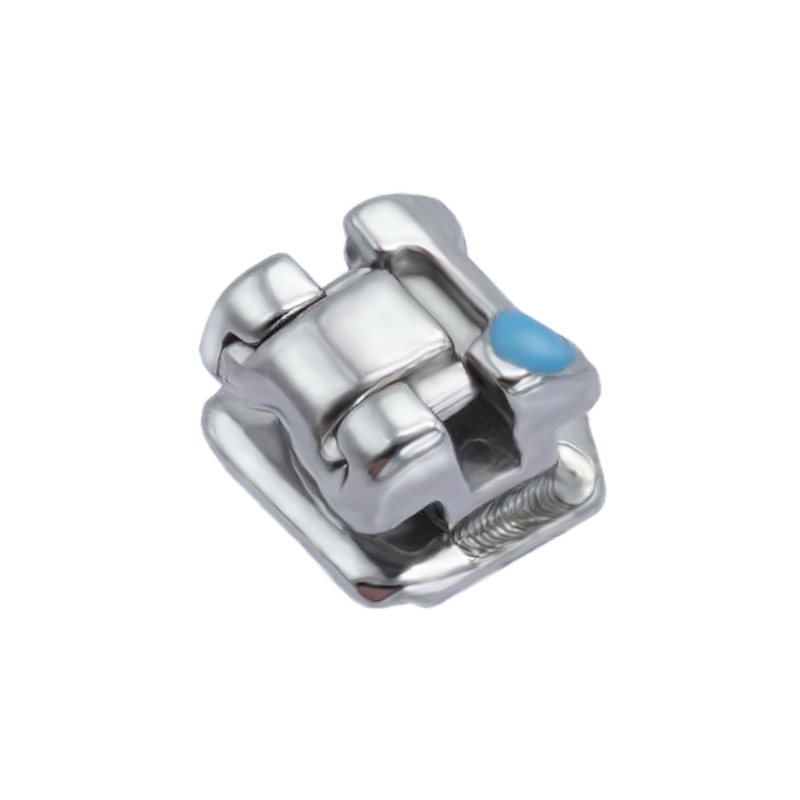
A passive self-ligating bracket uses an integrated rigid slide to close the bracket slot. Once closed, the slide creates an enclosed archwire channel and prevents the orthodontic archwire from disengaging from the bracket.
Unlike an active spring clip, which may deflect elastically after contacting the archwire, a passive slide primarily keeps the slot closed and does not actively push the archwire into position.
The term “passive” therefore describes how the ligation mechanism interacts with the archwire. It does not mean that the bracket cannot transmit orthodontic forces or provide rotation and torque control. The forces required for tooth movement still originate from archwires, orthodontic elastics, and other auxiliaries.
Although the passive slide generally remains stable after closure, the degree of archwire engagement changes according to archwire size and tooth position.
Engagement | Archwire-Slot Relationship | Typical Behavior |
Low engagement | A small-diameter archwire leaves greater clearance within the bracket slot | The slide mainly retains the archwire, which has greater freedom of movement |
Transitional contact | Archwire size increases, or tooth displacement causes local contact with the slot edges | Resistance to sliding and the level of control begin to change |
Greater engagement | A larger rectangular archwire fills more of the bracket slot | Contact with the slot walls increases, improving rotation control and torque expression |
These are not fixed treatment stages through which every tooth must pass in sequence. With the same archwire, different teeth may show different levels of engagement depending on their individual positions.
Initial alignment commonly begins with small, flexible round nickel-titanium archwires. At this stage, there is usually considerable clearance between the archwire and bracket slot. The passive slide mainly retains the archwire without continuously pressing it against the slot floor.
This design reduces contact created by an active ligating component pressing against the wire and allows the small archwire to retain a degree of freedom within the slot.
However, passive self-ligation does not mean that resistance to sliding is completely absent during initial alignment. If a tooth is severely rotated, tipped, or vertically displaced, the archwire may still contact the slot edges and produce binding.
Actual performance therefore depends on the degree of tooth displacement, archwire stiffness, and bracket–archwire angulation.


As orthodontic treatment progresses, clinicians generally increase archwire dimensions and introduce rectangular archwires during the middle and finishing stages. This reduces archwire-to-slot clearance and allows the slot walls to play a greater role in archwire positioning.
When the bracket and archwire are approximately parallel and the archwire dimensions are appropriate, a passive slide can reduce certain sources of friction associated with the ligation mechanism. In clinical orthodontics, however, the broader concept is resistance to sliding.
When a tooth is tipped or the archwire is deflected, binding between the archwire and slot edges can significantly affect space closure. Sliding efficiency therefore cannot be evaluated solely on the basis of “low friction.” Anchorage design, applied force, tooth angulation, and archwire deformation must also be considered.[1]
As archwire dimensions increase, contact between the archwire and slot walls becomes more extensive, improving rotation control and torque expression. The passive slide itself does not generate torque. Torque is transmitted primarily through contact between a rectangular archwire and the bracket slot walls.

Actual archwire dimensions, slot accuracy, manufacturing tolerances, bracket prescription, and bonding position can all affect the final level of torque expression.
Some in vitro studies have observed that an active clip may bring a rectangular archwire into functional slot engagement at a smaller torsional angle. A passive bracket generally needs to take up more archwire-to-slot clearance before comparable interaction begins.
This does not mean that passive self-ligating brackets cannot express torque. It means that their torque expression depends more heavily on the actual fit between the archwire and bracket slot.[2]
In vitro studies have found lower friction with passive self-ligating brackets than with active self-ligating brackets in certain bracket–archwire combinations. However, the results vary according to archwire dimensions, archwire material, and bracket–archwire angulation.[3][4]
Clinical studies have not demonstrated that these laboratory friction differences necessarily result in faster tooth movement.
A randomized controlled trial comparing active and passive self-ligating brackets found no significant difference in the time required to resolve maxillary anterior crowding in adolescents.[5]
Another clinical trial comparing active self-ligating, passive self-ligating, and conventional brackets found no significant difference among the three systems in the time required for space closure.[6]
A more accurate interpretation is that passive ligation can reduce specific sources of friction under appropriate conditions. Overall orthodontic treatment efficiency still depends on diagnosis, archwire sequence, anchorage strategy, and the complete biomechanical design of treatment.
The Sino Ortho Great Wall II Series uses a passive sliding mechanism to retain the orthodontic archwire within a closed bracket slot while preserving appropriate archwire freedom during the small-wire stage.
The series features a medical-grade stainless steel bracket body and precision laser-welded construction. Clear tooth-position identification numbers are provided on the bracket base to support clinical identification and bonding.
Great Wall II passive self-ligating metal brackets are available for orthodontic clinics, distributors, and bulk purchasers. OEM and ODM cooperation is also available for qualified volume orders.
[1] Comparison of resistance to sliding between different self-ligating brackets with second-order angulation in the dry and saliva states.
[2] Torque expression of self-ligating brackets.
[3] A comparative study of frictional force in self-ligating brackets according to the bracket-archwire angulation, bracket material, and wire type.
[4] Friction between various self-ligating brackets and archwire couples during sliding mechanics.
[5] Active or passive self-ligating brackets? A randomized controlled trial of comparative efficiency in resolving maxillary anterior crowding in adolescents.
[6] Comparative assessment of alignment efficiency and space closure of active and passive self-ligating vs conventional appliances in adolescents: a single-center randomized controlled trial.
[1] Active vs. Passive Self-Ligating Brackets: Key Differences and Selection Guide.
[2] How Do Active Self-Ligating Brackets Work?
Does “Passive” Mean That the Bracket Does Not Apply Force to the Tooth?
No. “Passive” only means that the rigid slide does not normally press the archwire continuously toward the slot floor.
The orthodontic force required for tooth movement is still produced by archwires, elastics, and other auxiliaries and transmitted to the tooth through the bracket.
Can Passive Self-Ligating Brackets Express Torque?
Can Passive Self-Ligating Brackets Shorten Treatment Time?
Should Clinicians Choose Active or Passive Self-Ligating Brackets?